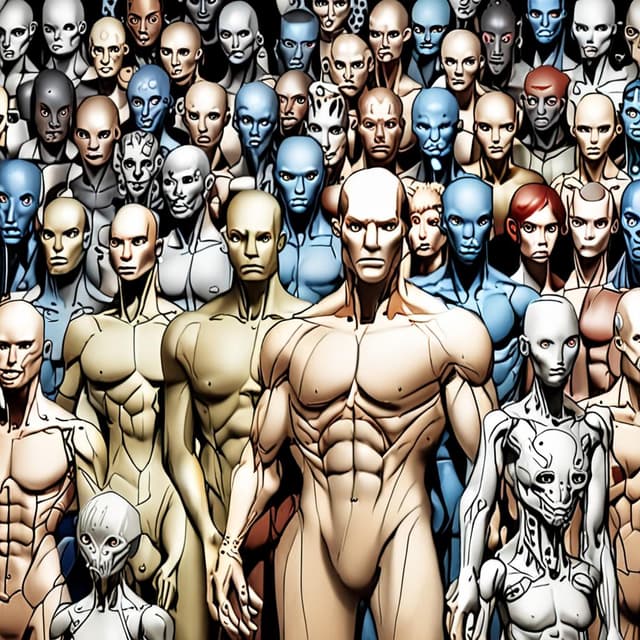
| Subject | Formerly human creatures |
| Perception | Celebrated by some for their incredible abilities • Feared and ostracized by others who see them as a threat to traditional human society |
| Description | Sentient beings that were once regular humans but have been genetically or cybernetically enhanced to possess superhuman physical and/or mental capabilities |
| Capabilities | Cybernetic implants • Genetic engineering • Digital mind uploading |
| Legal and Social Status | Highly contentious, raising complex questions about the definition of humanity, personhood, and rights |
In the modern era, the term "formerly human creatures" (FHCs) has emerged to describe a class of sentient beings that were once ordinary humans but have been significantly modified through technological and scientific means. These individuals possess enhanced physical and/or cognitive abilities that transcend the normal limits of the human body and mind. FHCs exist in a legal and social grey area, their enhanced nature raising profound questions about the definition of personhood, humanity, and rights.
The first FHCs began appearing in the late 20th century, as rapid advances in fields like cybernetics, genetic engineering, and mind-computer interfaces enabled the alteration of the human form and mind. Early cases included individuals who received extensive cybernetic implants or prosthetics to replace damaged or missing body parts. Others underwent experimental genetic therapies that granted them superhuman strength, speed, intelligence, or other abilities.
More recently, a new breed of FHCs has emerged - those who have "uploaded" their consciousness into digital platforms, transcending their original biological bodies altogether. These "transhumans" exist as disembodied, software-based minds, possessing cognitive capacities far beyond unmodified humans.
What unites all FHCs is their departure from the "natural" human state, and the resulting questions this raises. Are they still human, or have they become something else entirely? Do they retain the same rights and moral status as unmodified people? How should society integrate and regulate these enhanced creatures?
The legal and social status of FHCs remains highly contested. In many jurisdictions, they occupy a murky legal grey area, with laws and precedents struggling to keep pace with the rapid pace of technological change.
Some advocate for FHCs to be granted the full rights and protections of personhood, arguing that their enhanced nature does not negate their fundamental humanity. Others contend that FHCs pose a threat to traditional human society and should be strictly controlled or even outlawed. There are also debates over whether FHCs should be required to retain "human" limitations, or if they should be free to pursue limitless self-modification.
Socially, reactions to FHCs are mixed. Many view them with a combination of awe, envy and fear - awestruck by their incredible abilities, envious of the power they wield, but fearful of the disruption they could cause. FHCs often face discrimination, ostracization and even violence, particularly in more conservative or traditionalist communities. There are also growing subcultures and social movements championing the rights and interests of the FHC population.
The emergence of FHCs has triggered a host of profound philosophical, ethical and practical dilemmas for humanity. Some of the key debates and controversies include:
As the technology continues to advance, these debates are sure to intensify. The ultimate fate and status of FHCs remains uncertain, but their existence has undoubtedly ushered in a new era of unprecedented human transformation.
